
中文摘要:
结直肠癌(CRC)对大多数免疫疗法仍具有难治性,癌症疫苗由于免疫抑制性肿瘤微环境而失败。在这里,我们展示了β-葡聚糖诱导的训练免疫通过H3K4me3依赖的表观遗传修饰和代谢重编程重塑巨噬细胞,从而克服这些障碍。在接种了肽包被腺病毒疫苗PeptiCrad的雌性小鼠中,训练增强了糖酵解,肌酸代谢维持CXCL9/10的产生,使巨噬细胞能够通过CXCR3招募NK细胞。反过来,NK细胞产生CCL5,推动cDC1浸润和抗原呈递,这共同增强了效应记忆CD8⁺ T细胞应答。此外,在人体外周血单核细胞和CRC患者衍生的类器官中,训练的巨噬细胞增强了NK细胞迁移、抗原特异性T细胞激活和肿瘤杀伤。这些发现凸显了训练免疫作为强效佐剂,以重新激活结直肠癌疫苗应答的潜力。
英文摘要:
Colorectal cancer (CRC) remains refractory to most immunotherapies, with cancer vaccines failing due to an immunosuppressive tumor microenvironment. Here, we show that β-glucan–induced trained immunity overcomes these barriers by reprogramming macrophages through H3K4me3-dependent epigenetic modifications and metabolic rewiring. In female mice vaccinated with peptide-coated adenovirus-based vaccine PeptiCrad, training enhances glycolysis with creatine metabolism sustaining CXCL9/10 production, enabling macrophages to recruit NK cells via CXCR3. In turn, NK cells produce CCL5, driving cDC1 infiltration and antigen presentation, which together amplify effector memory CD8⁺ T cell responses. Moreover, with human peripheral blood mononuclear cells and CRC patient-derived organoids, trained macrophages boost NK migration, antigen-specific T cell activation, and tumor killing. These findings highlight trained immunity as a powerful adjuvant to reinvigorate colorectal cancer vaccination.
论文信息:
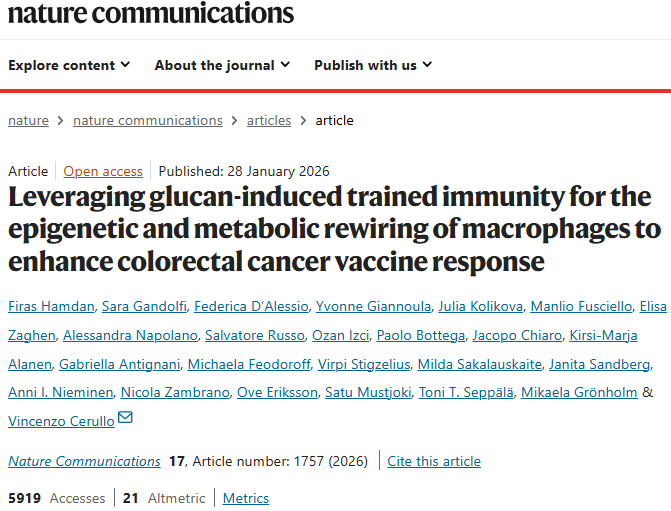
论文题目:Leveraging glucan-induced trained immunity for the epigenetic and metabolic rewiring of macrophages to enhance colorectal cancer vaccine response
期刊名称:Nature Communications
时间期卷:17, Article number: 1757(2026)
在线时间:2026年1月28日
DOI: doi.org/10.1038/s41467-026-68466-5
产品信息:
货号:C-005
规格:5ml
品牌:Liposoma
产地:荷兰
名称:Clodronate Liposomes氯膦酸盐脂质体
办事处:靶点科技
Clodronate Liposomes氯膦酸盐脂质体清除结肠癌小鼠肿瘤模型中巨噬细胞 ,荷兰Liposoma巨噬细胞清除剂ClodronateLiposomes见刊于Nature Communications:利用β-葡聚糖诱导的训练免疫对巨噬细胞进行表观遗传和代谢重编程以增强结直肠癌疫苗反应。
Liposoma巨噬细胞清除剂Clodronate Liposomes氯膦酸二钠脂质体清除肿瘤相关巨噬细胞的材料和方法:
For macrophage depletion, mice were administered i.p. with 200 µl of chlodronate liposomes (Liposoma, Cat# C-005) 1 day after tumor implantations and then every four days until the end of the experiment. As for NK depletion, mice were treated with 50 μl of anti-Asialo-GM1 antibodies (Purified anti-Asialo-GM1 Antibody, BioLegend, Cat # 146002) day after tumor implantations and given every four days until the end of the experiment. For depletion of both immune population, mice were treated with both treatments 1 day after tumor implanations and given every four days until the end of the experiment. For CD8 + T cell depletion, mice were given a bolus treatment of 500 µg of anti-CD8 antibody (BioXcell, Cat# #BE0061) given I.P 1 day prior the first PC treatment and was further sustained by injecting 100 µg of anti-CD8 antibody I.P every 3 days.
材料和方法文献截图:

研究结论示意图: