中文摘要:
建议将癌瘤转化为良性嗜酸性细胞瘤作为潜在的抗癌策略。嗜酸性细胞瘤的一个标志是缺乏呼吸链复合体 I(CI)。在这里,我们通过基因剔除这一酶来诱导两种癌症类型的惰性,并显示通过允许缺氧诱导因子-1α(HIF-1α)的稳定化可以逆转这种状态。我们进一步显示,从长远来看,缺乏CI的肿瘤会重新适应对缺氧的反应能力下降,这与人类嗜酸性细胞瘤的持续存在相一致。我们证明,即使缺乏CI的肿瘤无法稳定HIF-1α,它们仍然能够存活并进行血管生成。这种适应性反应是由肿瘤相关巨噬细胞介导的,荷兰Liposoma巨噬细胞清除清除剂clodronateliposomes清除巨噬细胞可改善CI剔除的效果。此外,通过二甲双胍药理学抑制CI功能和通过PLX-3397抑制巨噬细胞浸润的同时作用,在体内协同抑制肿瘤生长,为临床试验中高效组合辅助疗法奠定了基础。
英文摘要:
Converting carcinomas in benign oncocytomas has been suggested as a potential anti-cancer strategy. One of the oncocytoma hallmarks is the lack of respiratory complex I (CI). Here we use genetic ablation of this enzyme to induce indolence in two cancer types, and show this is reversed by allowing the stabilization of Hypoxia Inducible Factor-1 alpha (HIF-1α). We further show that on the long run CI-deficient tumors re-adapt to their inability to respond to hypoxia, concordantly with the persistence of human oncocytomas. We demonstrate that CI-deficient tumors survive and carry out angiogenesis, despite their inability to stabilize HIF-1α. Such adaptive response is mediated by tumor associated macrophages, whose blockage improves the effect of CI ablation. Additionally, the simultaneous pharmacological inhibition of CI function through metformin and macrophage infiltration through PLX-3397 impairs tumor growth in vivo in a synergistic manner, setting the basis for an efficient combinatorial adjuvant therapy in clinical trials.
论文信息:
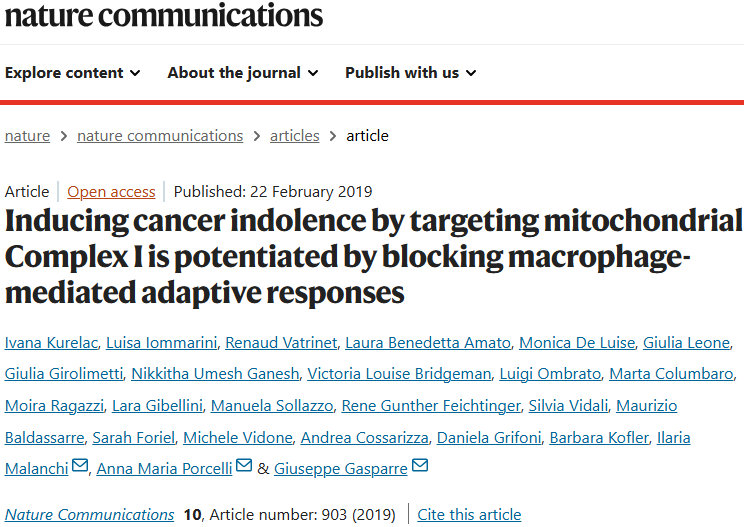
论文题目:Inducing cancer indolence by targeting mitochondrial Complex I is potentiated by blocking macrophage-mediated adaptive responses
期刊名称:Nature Communications
时间期卷:10, Article number: 903(2019)
在线时间:2020年2月22日
DOI: doi.org/10.1038/s41467-019-08839-1
产品信息:
货号:CP-005-005
规格:5ml+5ml
品牌:Liposoma
产地:荷兰
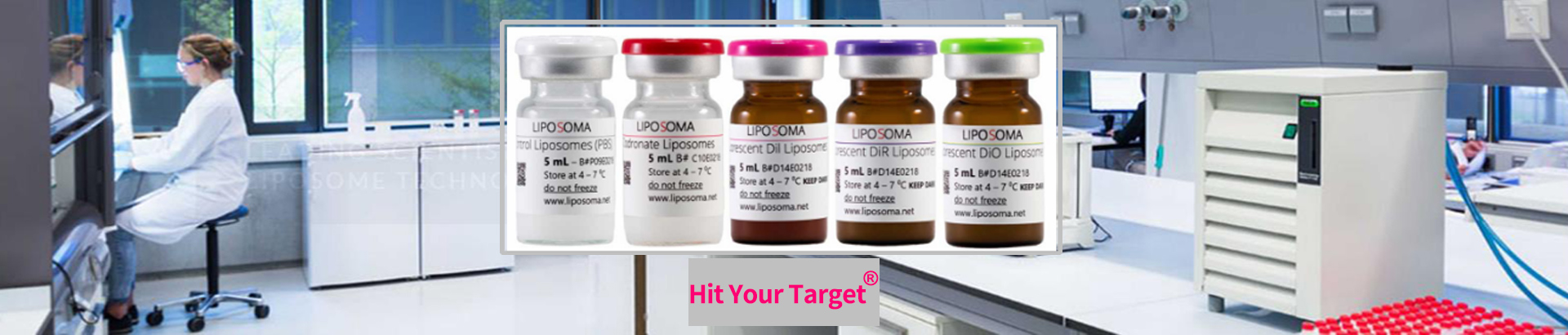
名称:Clodronate Liposomes& Control Liposomes
办事处:Target Technology(靶点科技)
Clodronate Liposomes氯膦酸盐脂质体清除病肿瘤型中巨噬细胞 ,荷兰Liposoma巨噬细胞清除剂ClodronateLiposomes见刊于Nature Communications:通过靶向线粒体复合体 I 来诱导癌症惰性,阻断巨噬细胞介导的适应性反应可增强其效果
Liposoma巨噬细胞清除剂Clodronate Liposomes氯膦酸二钠脂质体清除肿瘤相关巨噬细胞的材料和方法:
For the clodronate treatment experiments in Fig. 7c and Supplementary Fig. 17a–d, the animals were pre-injected intraperitoneally with PBS or clodronate liposomes (100 µL, ClodronateLiposomes, Liposoma BV) on the day prior to cell injection. On the day of tumor cell injection, 5 × 10⁶ cells in growth factor reduced matrigel (100 µL) were injected subcutaneously, immediately followed by injection of 40 µL of PBS or clodronate liposomes at the same position. The mice continued to receive intraperitoneal injection of liposomes twice weekly (100 µL).
材料和方法文献截图: