
中文摘要:
腱‑骨损伤患者因天然结构破坏导致运动功能受限,阻碍损伤恢复。传统生物材料侧重于增强肌腱 / 骨的再生能力以重建天然结构,但由于忽视免疫微环境且缺乏多组织再生功能,往往难以获得理想的修复效果。本研究将硅酸锰(MS)纳米颗粒与肌腱 / 骨相关细胞复合,制备出可用于腱‑骨一体化再生的免疫调节型多细胞支架。
值得注意的是,通过整合仿生细胞排布与硅酸锰纳米颗粒,该多细胞支架展现出多重生物活性。此外,硅酸锰纳米颗粒可通过调控巨噬细胞,促进支架内多细胞的特异性分化;该效应主要源于锰离子诱导巨噬细胞分泌前列腺素 E2(PGE2)。多项动物实验结果证实,该支架能够在腱‑骨界面实现免疫调节、一体化再生及运动功能恢复。
综上,基于无机生物材料构建的多细胞支架,为软 / 硬组织界面的免疫调控与一体化再生提供了创新思路。
英文摘要:
Limited motor activity due to the loss of natural structure impedes recovery in patients suffering from tendon-to-bone injury. Conventional biomaterials focus on strengthening the regenerative ability of tendons/bones to restore natural structure. However, owing to ignoring the immune environment and lack of multi-tissue regenerative function, satisfactory outcomes remain elusive. Here, combined manganese silicate (MS) nanoparticles with tendon/bone-related cells, the immunomodulatory multicellular scaffolds were fabricated for integrated regeneration of tendon-to-bone. Notably, by integrating biomimetic cellular distribution and MS nanoparticles, the multicellular scaffolds exhibited diverse bioactivities. Moreover, MS nanoparticles enhanced the specific differentiation of multicellular scaffolds via regulating macrophages, which was mainly attributed to the secretion of PGE2 in macrophages induced by Mn ions. Furthermore, three animal results indicated that the scaffolds achieved immunomodulation, integrated regeneration, and function recovery at tendon-to-bone interfaces. Thus, the multicellular scaffolds based on inorganic biomaterials offer an innovative concept for immunomodulation and integrated regeneration of soft/hard tissue interfaces.
论文信息:
论文题目:Immunomodulatory multicellular scaffolds for tendon-to-bone regeneration
期刊名称:Science Advances
时间期卷:Vol 10, Issue 10(2024)
在线时间:2024年3月8日
DOI: 10.1126/sciadv.adk6610
产品信息:
货号:CP-005-005
规格:5ml+5ml
品牌:Liposoma
产地:荷兰
名称:Clodronate Liposomes&Control Liposomes
办事处:靶点科技
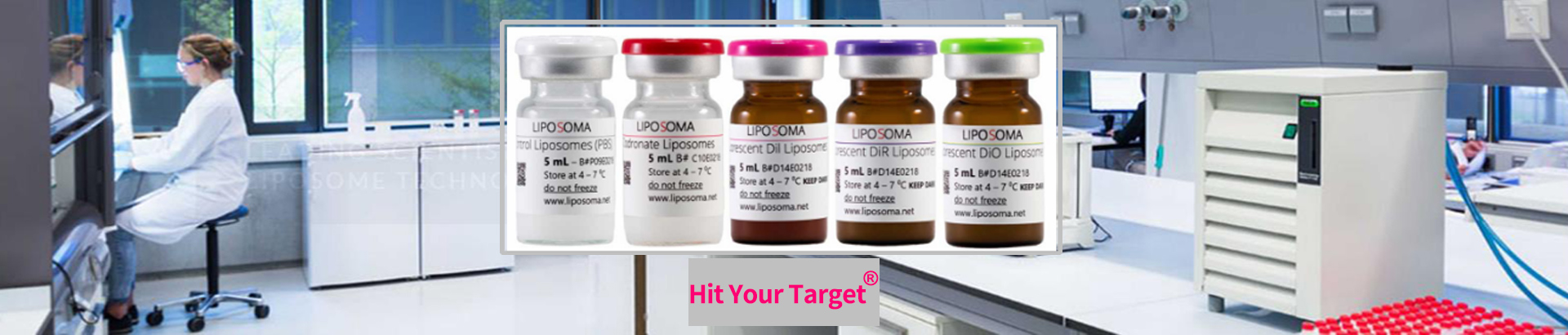
Clodronate Liposomes氯膦酸盐脂质体在肌腱 / 骨相关细胞复合模型种清除巨噬细胞。荷兰Liposoma巨噬细胞清除剂ClodronateLiposomes见刊于Science Advances:用于腱‑骨再生的免疫调节型多细胞支架。

Liposoma巨噬细胞清除剂Clodronate Liposomes氯膦酸二钠脂质体清除巨噬细胞的材料和方法:
Depletion of AMs
To investigate the effect of macrophage depletion on enhanced regenerative outcomes induced by the scaffolds containing MS nanoparticles, the macrophage depletion model of Sprague-Dawley rats was created according to a previous report (57). Clodronate liposomes (LIPOSOMA, Netherlands) were applied to deplete macrophages. First, the Sprague-Dawley rats (male, 6 weeks old) were randomly divided into two groups: one group was treated with liposome-encapsulated PBS (GelMA-cells-MS+PBS) and another group was treated with clodronate liposomes (GelMA-cells-MS+clodronate). All of the rats received injections on days 1 and 3 before the implantation of scaffolds. After being shaved, the backs of the rats were sterilized with iodine solution. Then, a subcutaneous cavity was created on the side of the back, enabling the insertion of a scaffold. The skin incision was closed by 4-0 Ethibond sutures. Subsequently, sterile liposomal clodronate or liposome-encapsulated PBS (50 mg/kg) was locally injected in the cavity every 3 days from the first postoperative day. After 2 weeks of operation, the rats were euthanized and the scaffolds were collected. When analyzing the above results, the researchers were blinded to the grouping of animals.
巨噬细胞清除材料和方法文献截图:用于腱‑骨再生的免疫调节型多细胞支架